Why Your Tesla Smells Like Vinegar or Wet Socks — And What Actually Fixes It
If your Model 3 or Model Y greets you with a sour, musty burst the moment the fan kicks on, it isn't in your head and it isn't your floor mats. It's biology, and there's a specific fix that most owners get half right.
What's actually happening
When your air conditioning runs, the evaporator coil gets cold — that's the entire point of it. Warm cabin air passes across it, and moisture in that air condenses on the cold metal, exactly the way a glass of ice water sweats on a summer afternoon.
Normally that water drains away and the coil dries out. But if you park before it dries — after a short trip, on a humid day, or after running the A/C hard on the way home — you've left a dark, damp, enclosed surface sitting overnight. Mold and mildew grow on it.
The next morning, the blower motor spins up and pushes air straight across that growth and out through your vents. That's the smell. Owners describe it as vinegar, wet socks, mildew, or a sour burst in the first few seconds before it fades. All of those are the same problem.
Short trips are the biggest driver. A 10-minute drive with the A/C on wets the coil but doesn't give it time to dry before you park. Owners who commute 45 minutes daily often never see this; owners running errands around town see it constantly.
Why replacing the cabin filter usually isn't enough
This is the part most people get wrong, and it's why so many owners replace their filters, enjoy a week of fresh air, and then find the smell creeping back.
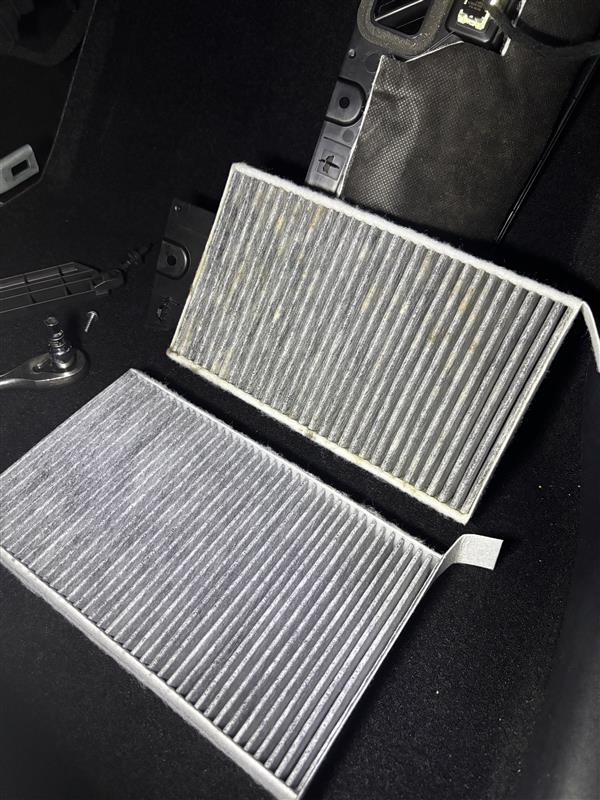
A dirty cabin filter can be the source. It holds dust, pollen, and damp debris, and it can develop its own odor. But it can just as easily be the symptom. If growth has already established itself on the evaporator core, a fresh filter improves airflow and masks the problem briefly — then the odor returns, because the actual source is still sitting there, untouched, a few inches upstream.
Swapping the filter without treating the evaporator is like putting a clean shirt on without showering. It helps for a while. It doesn't solve anything.
What actually fixes it
Two things, done together, in this order:
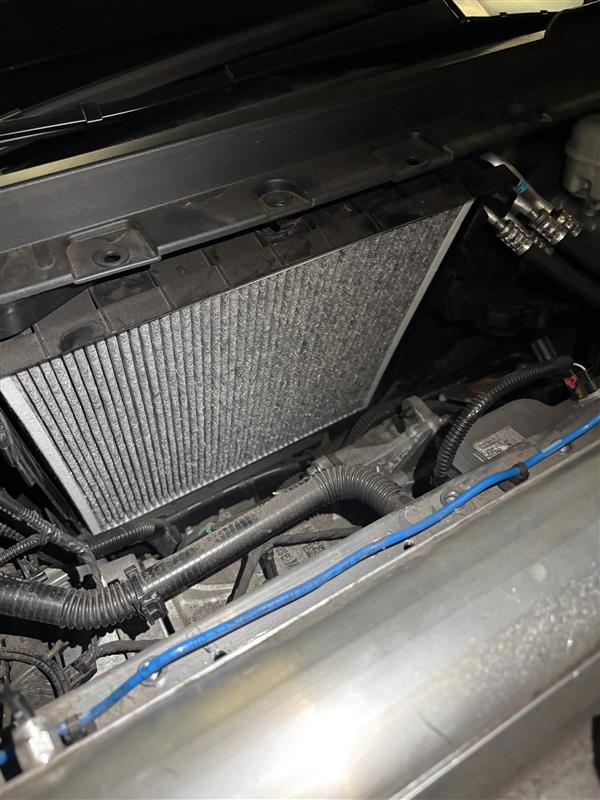
- Treat the evaporator core. An evaporator cleaner — we use Kool-It — is applied into the HVAC intake so it reaches the coil surface and kills the growth living on it. This is the step that addresses the source.
- Replace both cabin air filters. Model 3 and Model Y take two. Doing this at the same time means you're not blowing clean air across a dirty coil, or dirty air across a clean one.
Done together, this resolves the overwhelming majority of Tesla A/C odor cases. Done separately, it frequently doesn't hold.
What Tesla charges, and what they include
| Service | Tesla Mobile | Quick Mobile Service |
|---|---|---|
| Cabin air filter replacement | $130 | $95 |
| Evaporator treatment | Not included | Included |
| Comes to your driveway | Yes | Yes |
Tesla has also pushed software updates that run the cabin fan for a period after you park, specifically to dry the evaporator and reduce this problem. It helps. It doesn't undo growth that's already established.
When it's something worse
Here's the honest caveat, and it matters: if the smell comes back within a few weeks of a proper evaporator cleaning and filter replacement, you're probably not dealing with ordinary condensation.
Some Model 3 and Model Y cars take on water through the cowl area below the windshield, where it can find its way into the HVAC intake. That's a continuous water supply feeding the problem, and no amount of cleaner will outrun it. That's a Tesla service center issue — often covered under warranty — not something a maintenance visit will solve.
We'd rather tell you that up front than sell you a treatment every three months that was never going to stick.
How often should you do this?
Tesla recommends replacing the cabin air filter roughly every two years on Model 3 and Model Y. Model Y HEPA filters run closer to every three years.
If you drive mostly short trips in Orange County — school runs, errands, a 15-minute commute — consider it maintenance rather than a repair, and don't wait until it smells.
Mobile Cabin Filter Replacement — $95
Includes both filters and Kool-It evaporator treatment, done at your driveway anywhere in South Orange County. About 30 minutes. Licensed CA ARB #313558 and fully insured.